
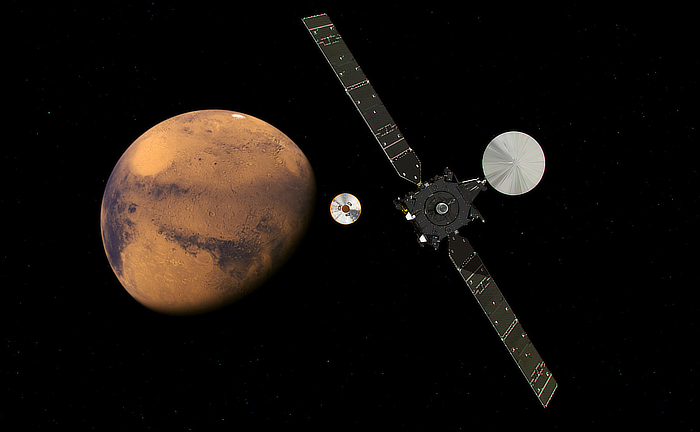
Is there life on Mars? Europe and Russia may not agree or cooperate on everything but they are working together successfully on a joint mission to Mars. Europe has provided the two probes and Russia the heavy lifting gear, that is a four-stage Proton-M/Breeze-M rocket. The mission lift-off on Monday (March 14th) went without a hitch and the rocket phoned home as planned at 21.30 GMT today.
The joint ESA-Roscosmos mission to Mars will take seven months to reach the red planet when it it begin a series of studies looking primarily at the atmosphere. The Proton-M released the payload fairing around 10 minutes after lift-off. The Breeze-M upper stage, with the two probes attached then completed a series of four burns before the spacecraft was released. The orbiter’s solar wings were then unfolded.
Johann-Dietrich Woerner, the Director General of ESA said “It’s been a long journey getting the first ExoMars mission to the launch pad, but thanks to the hard work and dedication of our international teams, a new era of Mars exploration is now within our reach.”
The first probe, the Trace Gas Orbiter (TGO), will enter an elliptical four-day orbit when separation occurs on 16th October at a distance of 900,000km from the planet. The TGO will perform detailed, remote observations of the Martian atmosphere, searching for evidence of gases of possible biological importance, such as methane.
The second probe, the Schiaperelli, will enter the Martian atmosphere and descend to the surface in less than six minutes. The Schiaparelli is expected to survive on the surface of Mars for a short time by using the excess energy capacity of its batteries. The science possibilities of Schiaparelli are limited by the absence of long term power and the fixed amount of space and resources that can be accommodated within the module; however, a set of scientific sensors are included to perform limited, but useful, surface science.
Apart from the excitement of detecting life on Mars, questions will always be raised about the usefulness of these experiments. Could the 1.2 billion Euros be better utilised here on Earth? No doubt the technological advances will prove useful in the long term but at a time of economic uncertainty and social disruption should we be investing in things closer t home?