Around 2000 tonnes of feather waste is produced every week by the poultry industry. Most ends up as land fill or goes through an energy intensive process to be turned into animal feed. The industry pays £63 per tonne to dispose of feather waste and is looking for more commercial and environmental friendly alternatives.
Enter Imperial College’s Professor Chris Cheeseman who tasked his students to research into potential uses for feather waste. Design engineering student Elena Dieckmann threw herself into the project by ordering a 10 kg box of feathers with no idea what to do with them. In the end, the solution seemed obvious. Feathers are used by chickens to protect themselves and keep warm, surely they could be used to keep people’s houses warm? The problem to be solved was how to turn loose feathers into a substance that could become a workable builders solution.
Dieckmann enlisted the help of two fellow students, Ioannis Tzouganatos a chemical engineer and Ryan Robinson a biologist. Together they are developing a way to combine chicken feathers with polyurethane foam board insulation. So far they have found that the optimum mix is around 30% feathers / 70% board foam. The new material appears to have the same insulating properties as standard polyurethane foam board insulation.
The new material has been named FeatherFill™ by Dieckmann who says on her Innovation Design Engineering website “To convert the feathers into insulation boards a unique process is required. Our products will incorporate the additional advantageous properties of feathers such as sound absorption, flame-retardation, water-repulsion and pest-resistance. Our novel products are advantageous as they are biodegradable in landfill without toxic by-products, and replace environmentally harmful conventional synthetic insulation materials.”
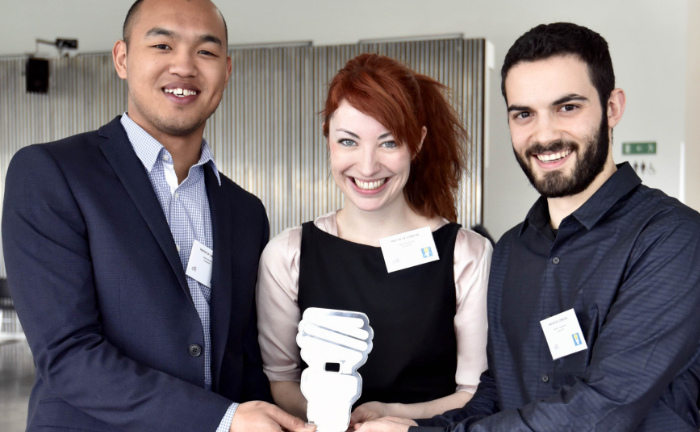
The project is a bold and ambitious one for a small team of students but it is just the sort of innovation that is needed in the United Kingdom. The team has a long way to go before the material is deemed as an acceptable product by both the building and standards agencies. The Dieckmann team have recently won the Mayor of London’s Low Carbon Entrepreneur 2016 award.